A University of Illinois alumnus and Northwestern Medicine physician, Dr. Jason Rice is turning to the Brotherhood he found at Chi Zeta for help sharing his story.
A high school friend introduced Dr. Jason Rice (Illinois, ’03) to Lambda Chi Alpha during his second semester at the University of Illinois. As he got to know the Brothers of Chi Zeta, he saw what recruiting for character looked like. The men he met came from across the country, studied different subjects and brought different backgrounds and interests to the Chapter.
“What really made me realize Lambda Chi Alpha was the right fit for me was that there really was not any specific ‘type’ that they were looking for,” Rice said.
The friend who introduced him to Chi Zeta became his best friend. More than 20 years after graduation, many of his Chapter Brothers are still among the people he is closest to. Today, Rice is turning to those Brothers and the wider Lambda Chi Alpha community for help finding a living kidney donor.
“Lambda Chi Alpha was my family in college, and many of my brothers have remained my closest friends 20+ years later,” Rice said.
From advertising to medicine
 Rice and his wife met in high school and dated long-distance while he attended Illinois and she attended Drake University, where she was a member of Kappa Alpha Theta. They got engaged the weekend he graduated in 2003. A few years later, when Rice decided to leave advertising for medicine, she supported him through the career change. He completed his pre-med coursework at Loyola University Chicago in the evenings while still working full time at an agency.
Rice used to joke that he went into medicine so he could live out an episode of Scrubs. In medical school, he discovered how much he enjoyed teaching patients about their health. He wanted them to understand what was happening and why a treatment might help.
Now a primary care physician at Northwestern Medicine, Rice helps patients manage chronic conditions, address new concerns and stay healthy through preventive care. His own experience as a patient has given him a better sense of how much he asks of them.
“Frequent appointments with different doctors, dietary restrictions, medications, labs and tests can all feel pretty overwhelming at times,” Rice said. Going through those experiences himself has helped him connect with patients facing similar demands.
What a transplant would mean
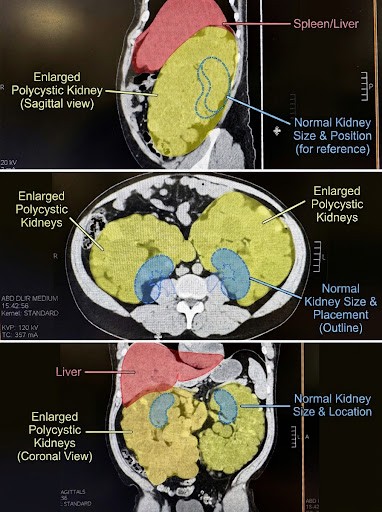 Rice learned he had autosomal dominant polycystic kidney disease in 2011, while he and his wife were expecting their first child. He was applying for life insurance and got screened because both his mother and grandmother had the disease. The inherited condition causes fluid-filled cysts to grow in the kidneys. Over time, the kidneys can enlarge and lose function.
Rice is on the transplant waiting list and hopes to receive a kidney from a living donor before he needs dialysis. His mother received a kidney transplant in 2006, and he says her transplanted kidney is still doing well. As he prepares for a transplant of his own, he draws hope from the years his mother has had since hers.
For Rice, a transplant would mean continuing to care for his patients and being there with his wife as their two sons grow up. His wife is now home full time with the boys. Their oldest is 14 and a freshman in high school. He plays baseball, guitar, bass and saxophone. Their youngest is 11 and in sixth grade. He plays lacrosse and soccer. Outside the office, Rice spends much of his time with his family at the boys’ games. He also enjoys cooking and playing guitar, an interest he shares with his older son.
“I want to be around for a long time for everyone that I care for and everyone that depends on me,” Rice said.
How Brothers can help
Rice is an only child with few close relatives he can turn to as potential donors. He is asking Brothers to share his story and inviting anyone interested in living donation to learn more through his donor page.
Through Northwestern Medicine’s KidneyMatch program, a willing donor who is unable to donate directly to Rice may still be able to help through paired donation. If the transplant team finds a compatible exchange, that donor can give to another recipient while Rice receives a kidney from a different donor. Learn more about kidney paired donation at Northwestern Medicine.
If you are interested in donating, Rice’s page links to Northwestern Medicine’s living donor questionnaire. You can also help by sharing the page with your Chapter, alumni network, friends or family.
Visit Jason Rice’s living kidney donor page.